The Natural Remedies I Always Keep on Hand for My Home & Pets
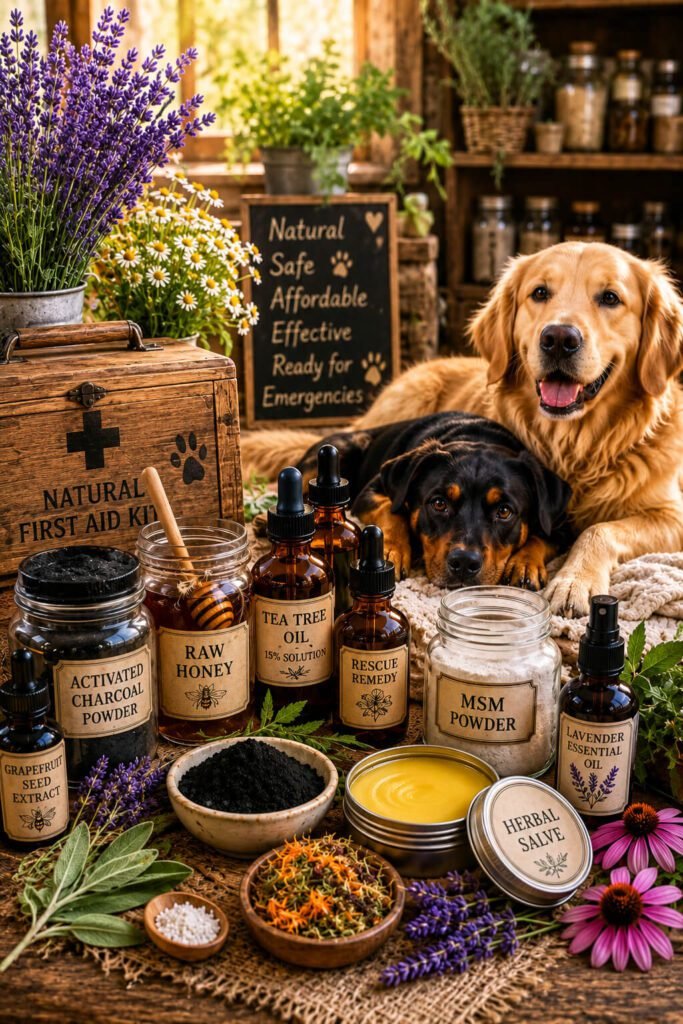
🌿 Free Printable Guide
Want a printable copy of these remedies you can save for later?
I put together a free printable of my 16 favorite remedies so you always have them handy. Grab it below if you want it.”
1. Activated Charcoal
Last summer I was walking down the driveway with four six-month-old puppies when chaos broke loose. All of them suddenly went wild — jumping at a tree, one did a complete backflip, two wouldn’t leave whatever they’d found alone. I knew immediately. Rattlesnake.
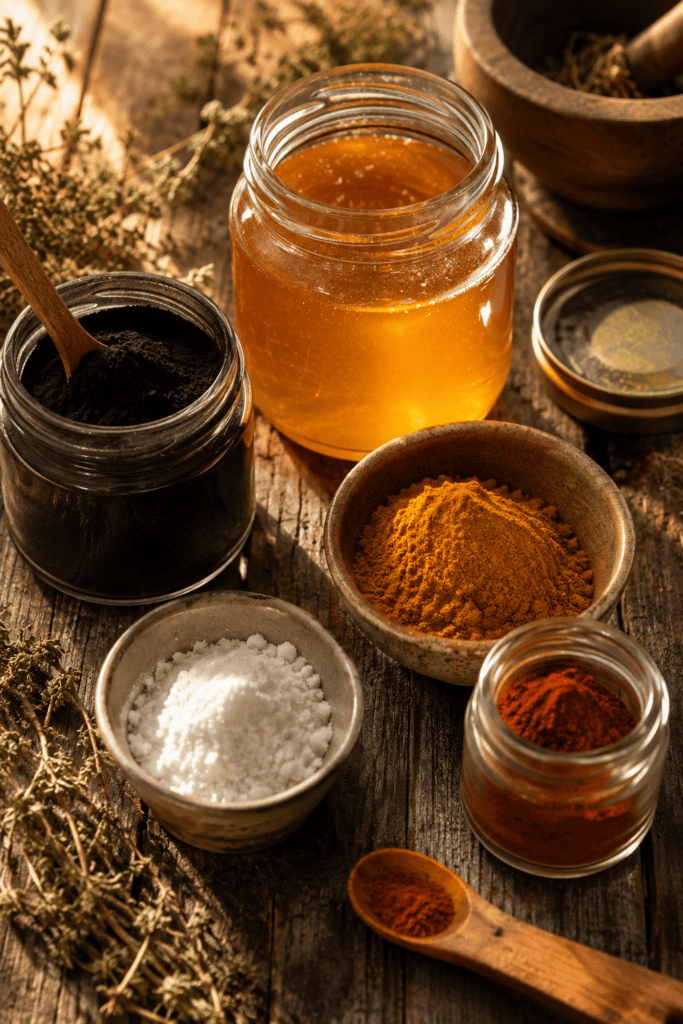
Three of them got bit. I couldn’t get all three to a vet for antivenom so I went straight to my cabinet and made what I now call my magic mix — activated charcoal, MSM crystals, turmeric, cayenne, and raw honey mixed into raw hamburger. I gave it to them twice before bed and held my breath.
By the next morning their faces — which had swollen to nearly twice their normal size, I still don’t know how they were eating — had almost completely gone back to normal. All three fully recovered.
I’ve used this combination for poisonous snake and spider bites several times since. It works every time.
Activated charcoal is the foundation of that mix. It binds to toxins in the digestive system and helps pull them out of the body before they can do more damage. I keep a large supply on hand always — for my animals and for myself.
2. Raw Honey
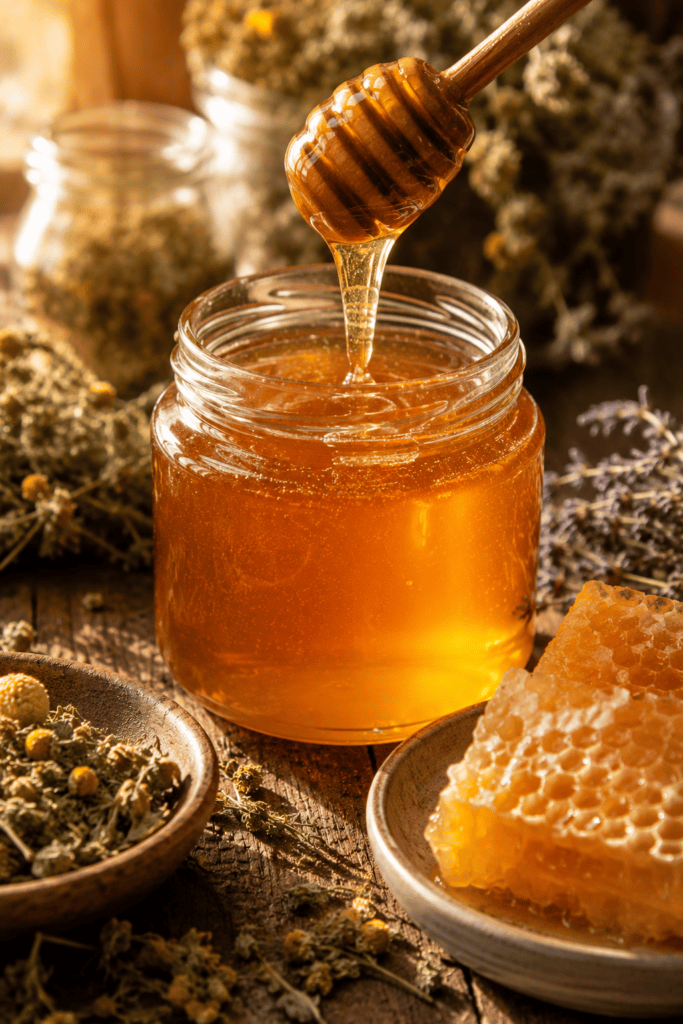
I always knew honey was good for wounds. I didn’t know how good until my one-year-old puppy was attacked by a wild boar.
I found him the next morning laying in a kennel in complete shock, barely able to walk. His face was clawed and torn. A chunk of his lip was ripped away under his nose. His CCL was torn. Cuts and bites all over his body. And a hole in his back so large and deep it was heartbreaking to look at.
He was in so much pain I could barely touch him. I packed the hole in his back with honey, kept it covered, and let it work.
I had started with silver and honey cream on the wound — it’s remarkable stuff — but the volume I was going through made it expensive so I switched to raw honey alone. What happened next genuinely surprised me. Every laceration healed faster than I’ve ever seen wounds heal. The hole in his back closed. His face healed. The only reminder is a patch on his back where the fur hasn’t grown back — and may never — but the wound itself is completely gone.
Raw honey is antibacterial, antimicrobial, and creates a healing environment that seems to accelerate tissue repair in a way that’s hard to explain until you’ve watched it work on something that serious. I pack it on wounds, give it internally for trauma and illness, and mix it into my emergency remedy combinations. It belongs in every home and every barn.
3. DMSO
DMSO (dimethyl sulfoxide) is After the boar attack my puppy’s CCL — the knee ligament — was torn. He needed surgery I couldn’t afford. So I went to work with what I had.
MSM with vitamin C internally twice a day every single day. DMSO applied externally directly to his knee and leg.
He is running now.
His knee is occasionally unstable — a torn CCL without surgical repair will always have some weakness — but he’s active, he’s happy, and except for the patch of missing fur on his back you would never know what happened to him.
DMSO is one of the most powerful and misunderstood substances in natural medicine. It penetrates skin completely and carries whatever it’s combined with directly into tissue — which is why I use it on joints, on injuries, and on anything that needs treatment at a deeper level than topical application can reach. It reduces inflammation, improves circulation, and supports tissue healing in ways that conventional medicine largely ignores.
It has a strong smell — you and your pet will both smell like garlic for a bit — but I’ll take that over watching an animal suffer from something I might be able to help.
If you have animals — especially large ones, horses, working dogs — DMSO belongs in your cabinet. Learn how to use it correctly and it will earn its place every single time.
4. Castor Oil
When I don’t know what else to do, I try castor oil. That’s not an exaggeration — it’s become my first instinct for anything that isn’t responding to my usual remedies.
Recently Darren developed a horrible itchy rash on his neck that spread to his chest and arms. I’m pretty sure it started as a heat rash — we’ve had nearly 100 degree days for weeks — but it escalated fast and nothing I tried was touching it. Silver and honey cream helped with the short-term discomfort but didn’t clear it. MSM internally calmed it down overnight and I thought we had it — then it came roaring back full force in the heat.
Castor oil combined with comfrey salve finally did it. The rash is almost completely gone now.
That’s how castor oil works in my house — it’s the remedy I reach for when everything else has helped a little but not enough. It draws, it heals, it reduces inflammation in a way that’s hard to explain until you’ve watched it work on something that wasn’t responding to anything else.
I use it constantly — on skin issues, joint pain, inflammation, lymphatic congestion. Topically on animals for wounds, swelling, and anything that needs to be drawn out. If you don’t have castor oil in your cabinet yet, fix that today.
Those are the ones I have the most dramatic stories about. But my cabinet is full of other staples that earn their place every single day in quieter ways:
5. MSM Powder
MSM (methylsulfonylmethane) is another staple I never want to run out of.
I personally keep it around for:
- joint support
- soreness
- recovery support
- skin support
- general wellness
It’s inexpensive, lasts a long time, and mixes easily into liquids.
I originally started using it years ago and now it’s just one of those things I automatically reorder before I run low.
Tea tree oil is one of the most powerful natural disinfecting oils I keep around.
6. Tea Tree Oil
For pet use, I personally dilute it carefully before applying it topically.
I keep it on hand for:
- cuts and scrapes
- hot spots
- fungal issues
- ringworm
- abscesses
- infected skin
- tick bites
- minor wound support
A tiny amount goes a long way.
Because essential oils are extremely concentrated, I always recommend researching proper dilution and being cautious around pets.
Lavender is probably the essential oil I use the most overall.
7. Lavender Essential Oil
It’s incredibly versatile and has earned a permanent place in my natural remedy cabinet.
I personally use lavender oil for:
- burns
- skin irritation
- calming support
- stressful situations
- homemade sprays
- wound support
- bedtime relaxation
I also like keeping diluted lavender available around rescue dogs during stressful transitions, storms, or travel situations.
There are many other essential oils I use occasionally, but lavender is definitely one I never want to be without.
8. Grapefruit Seed Extract
Grapefruit seed extract is something I don’t hear people talk about nearly enough.
I personally keep both:
- liquid grapefruit seed extract
- capsules
on hand.
Traditionally, it has been used for:
- skin support
- fungal issues
- wound care
- household cleaning
- wellness support
The liquid version is very strong and I personally dilute it for larger areas.
This is another one of those products that ends up being surprisingly versatile once you start using it regularly.
9. Herbal Salves
A good all-purpose herbal salve is one of the most comforting things to keep in a first aid kit.
I use salves constantly for:
- cuts
- scrapes
- dry skin
- irritated skin
- cracked paws
- healing support
- protecting wounds under bandages
I especially like salves containing herbs like:
- calendula
- comfrey
- plantain
Some salves are better during early wound care, while others are better later in the healing process, so I like keeping more than one type on hand.
🌿 Enjoying this list?
If you’d like a printable version you can keep handy, grab my free guide below.
10. Aloe Vera
I always keep both:
- live aloe plants
- bottled aloe gel
around the house.
Aloe is incredibly soothing and useful for:
- burns
- bug bites
- skin irritation
- hot spots
- dry skin
- minor cuts
Fresh aloe from the plant is hard to beat.
It’s one of the simplest natural remedies out there, but also one of the most effective.
11. Apple Cider Vinegar
Apple cider vinegar is probably one of the most-used things in my entire home.
I use it for:
- homemade cleaners
- wellness drinks
- herbal preparations
- natural household uses
- scalp rinses
- occasional pet-related uses
I prefer raw, unfiltered apple cider vinegar whenever possible.
12. Bentonite Clay
Clay is another emergency staple I always keep stocked.
I personally use bentonite or green clay for:
- clay poultices
- skin support
- detox-support mixtures
- digestive support
- diarrhea support
- drawing poultices
Clay has been traditionally used for generations as a natural way to help draw impurities from the skin.
It’s incredibly useful to have around.
13. Dr. Bach’s Rescue Remedy
Rescue Remedy has become one of my favorite things to keep around for stressful situations.
If you’ve ever dealt with frightened rescue dogs, injured animals, thunderstorms, fireworks, or stressful travel, you understand how valuable calming support can be.
I personally keep Rescue Remedy on hand for:
- rescue situations
- storms
- anxious dogs
- travel
- stressful transitions
Sometimes even a little calming support can make a huge difference.
14. Homeopathic Remedies
Homeopathic remedies are an entire category of natural support that I’ve grown to appreciate more and more over the years.
There are dozens I keep around, but a few beginner remedies I personally like having on hand include:
- Arnica Montana
- Apis
- Aconitum
- Hypericum
- Ledum
- Calendula
- Carbo Vegetabilis
These tiny pellets take up almost no space, last a long time, and can be incredibly useful additions to a natural first aid kit.
I plan to write a separate article covering some of the individual remedies I personally keep and why.
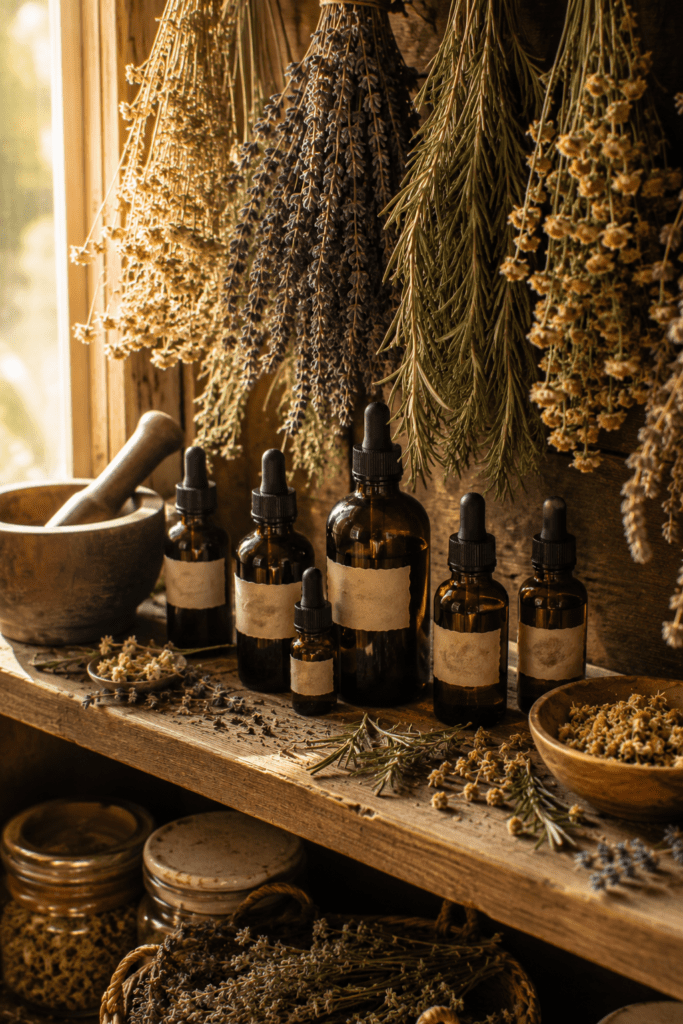
Dried herbs are one of the foundations of my natural remedy cabinet.
15. Dried Herbs
Some of my most-used herbs include:
- comfrey
- plantain
- echinacea
- yarrow
- slippery elm
- chamomile
- peppermint
I use herbs in:
- teas
- salves
- poultices
- herbal preparations
- soothing blends
I especially love keeping herbs around because they feel both practical and comforting at the same time.
Tinctures are concentrated herbal extracts that are easy to store and very convenient during emergencies.
16. Tinctures
Some of the tinctures I personally keep include:
- arnica
- calendula
- cayenne
- echinacea
- bee propolis
I love tinctures because:
- they last a long time
- they’re portable
- they’re fast to use
- a little goes a long way
They’re especially useful in rural settings where you may not want to scramble for supplies during an emergency.
17. Turmeric
Turmeric is one of the oldest and most widely used herbs in traditional wellness practices around the world. The bright yellow-orange root contains compounds called curcuminoids, which have made turmeric a staple in both herbal medicine and cooking for centuries.
I always keep turmeric powder in my pantry because it’s inexpensive, versatile, and easy to add to everyday routines.
I personally use turmeric for:
- General wellness support
- Recovery after physical exertion
- Joint and mobility support
- Homemade herbal blends
- Golden milk and wellness drinks
- Adding to homemade pet supplements
One thing many people don’t realize is that turmeric is absorbed much better when combined with black pepper and a healthy fat such as coconut oil.
Because it has such a long history of traditional use, turmeric has earned a permanent place in my natural remedy cabinet.
18. Cayenne Pepper
Most people think of cayenne as a kitchen spice, but I consider it one of the most important herbs in my entire home.
Traditional herbalists have relied on cayenne for generations because of its reputation for supporting healthy circulation and warming the body. It is one of those remedies that I never want to be without.
I personally keep cayenne powder, capsules, and cayenne tincture on hand.
Some of the traditional uses of cayenne include:
- Supporting healthy circulation
- Herbal first aid preparations
- Warming teas during cold weather
- Traditional bleeding-support applications
- Homemade wellness blends
- Emergency preparedness kits
A little goes a very long way, so even a small container can last for years.
Whether I’m making herbal remedies, wellness drinks, or stocking my emergency supplies, cayenne is always one of the first things I replace when I start running low.
Final Thoughts
Over the years, I’ve realized that preparedness doesn’t have to mean fear.
For me, it simply means keeping a few trusted remedies on hand before I need them.
These are the natural staples I personally continue reaching for again and again while caring for animals, living in the country, and trying to support wellness naturally whenever possible.
Some are incredibly simple.
Some are old-fashioned.
Some are probably unfamiliar to people who didn’t grow up around natural remedies or homesteading culture.
But every single thing on this list has earned a permanent place in my home for a reason.
And honestly, I sleep a little better knowing they’re there.