When You Lose a Pet — What Actually Helps
Nobody tells you how loud the silence is.
Not the silence of a quiet house — you’ve experienced that. This is different. This is the silence where a sound used to be. The jingle of a collar. The soft thud of paws on hardwood. The particular way they settled in for the night. The sounds so ordinary you stopped hearing them years ago — until the day they stopped, and suddenly that’s all you can hear.
Losing a pet is one of the most disorienting griefs there is. Not because it’s the largest loss a person can experience — though for many people it genuinely is — but because the world doesn’t always stop for it. You’re expected to show up the next day. To be fine. To move on with a reasonable timeline that has nothing to do with how deeply that animal was woven into your life.
This is for the people who aren’t fine yet. Who don’t know when they will be. Who loved an animal — a dog, a cat, a horse, a donkey, a rabbit, a bird, any living creature that looked at them and knew them — and are now figuring out how to live in the space where that love used to have somewhere to go.
Here’s what actually helps.
Let It Be As Big As It Is
The first and most important thing is also the hardest: stop minimizing it.
Stop saying “I know it’s just a pet.” Stop apologizing for how much you’re hurting. Stop measuring your grief against other people’s losses and finding yours insufficient.
An animal who lived beside you — who knew your routines, your moods, your voice, the specific way you moved through your own home — that animal was not replaceable and their absence is not small. The grief is exactly as large as the love was. And if the love was large, the grief will be too.
You don’t have to justify that to anyone.
Understand That Every Species Leaves a Different Shape
A dog and a cat and a horse and a donkey are not interchangeable losses — and if you’ve loved more than one kind of animal you already know this.
A dog is a constant. They reshape your entire day around their presence — the walks, the feeding schedule, the way they greet you like every return is a miracle. Losing a dog is losing a whole rhythm of life. The morning walk that suddenly has nowhere to go. The leash by the door. The bowl that needs to come down from the counter eventually but not yet.
A cat is a choice. Cats give their love selectively and being chosen by one is an honor they don’t hand out easily. Losing a cat is losing something you earned — a trust that took time and patience and was never guaranteed. The windowsill. The warm weight that isn’t there anymore. The purr you could always feel before you could hear it.
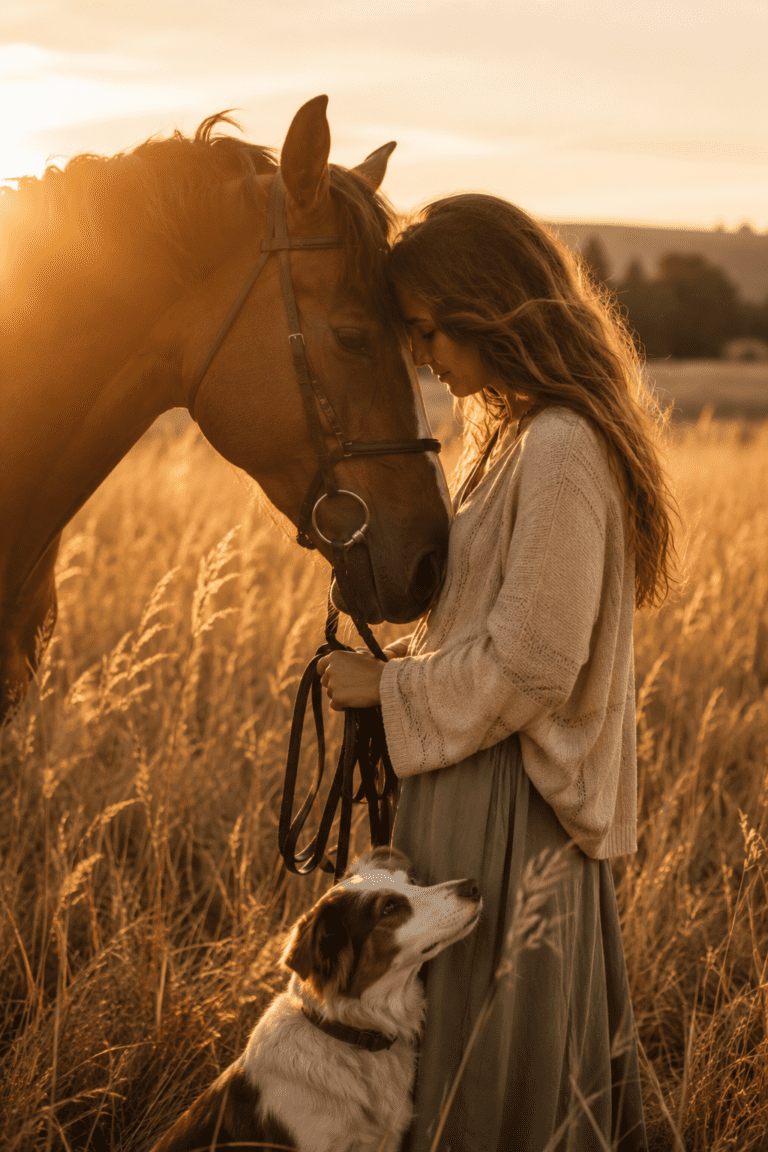
A horse is a partnership. You built something together over years — a language, a trust, a way of moving through the world side by side. Losing a horse is losing a collaborator, a companion in the truest sense, someone who went where you went and carried you through things that had nothing to do with riding. The barn is the hardest part. The smell of it. The empty stall.
A donkey is something else entirely — stubbornly, completely, impossibly themselves. Anyone who has loved a donkey knows that what you lose when they go is a whole enormous personality that existed nowhere else in the world and will never exist again exactly that way.
Whatever animal you lost — the shape of that loss is specific to them and to you. Don’t let anyone tell you it should feel smaller than it does.
Find the People Who Understand
Grief needs witnesses. It needs people who don’t shift uncomfortably when you bring up your pet’s name six months later. Who don’t suggest you get another one too quickly. Who understand that you’re not ready for that conversation and maybe won’t be for a long time.
Those people exist. They’re in online communities, in breed-specific groups, in the comment sections of articles like this one. They’re the friend who had a horse and lost one and still tears up talking about it years later. They’re the neighbor who understands exactly why you can’t walk the old trail yet.
Find them. Talk to them. Say your animal’s name out loud as often as you need to.
Do Something With the Love
Grief is just love with nowhere to go. And love, when it has no outlet, gets very heavy.
Give it somewhere to go.
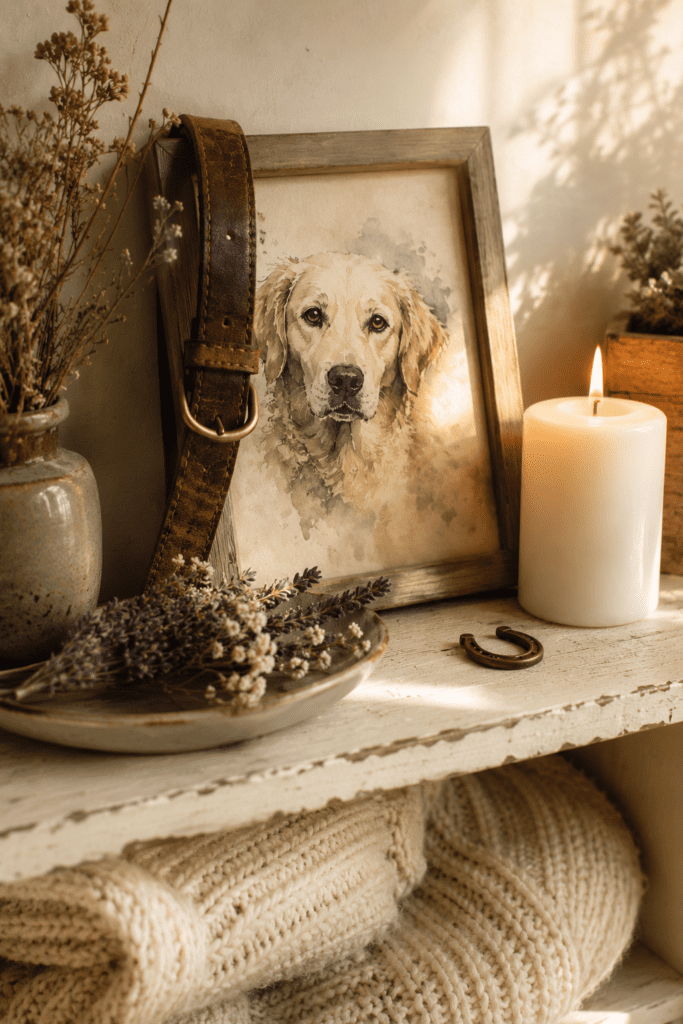
Plant something in their honor — a tree, a garden bed, a pot of flowers that blooms every spring and makes you think of them on an ordinary Tuesday in April. Write down the stories before they blur — the specific ridiculous wonderful details that made them entirely themselves. Frame the photos that are buried in your phone. Create something that holds the evidence of their life and your life together.
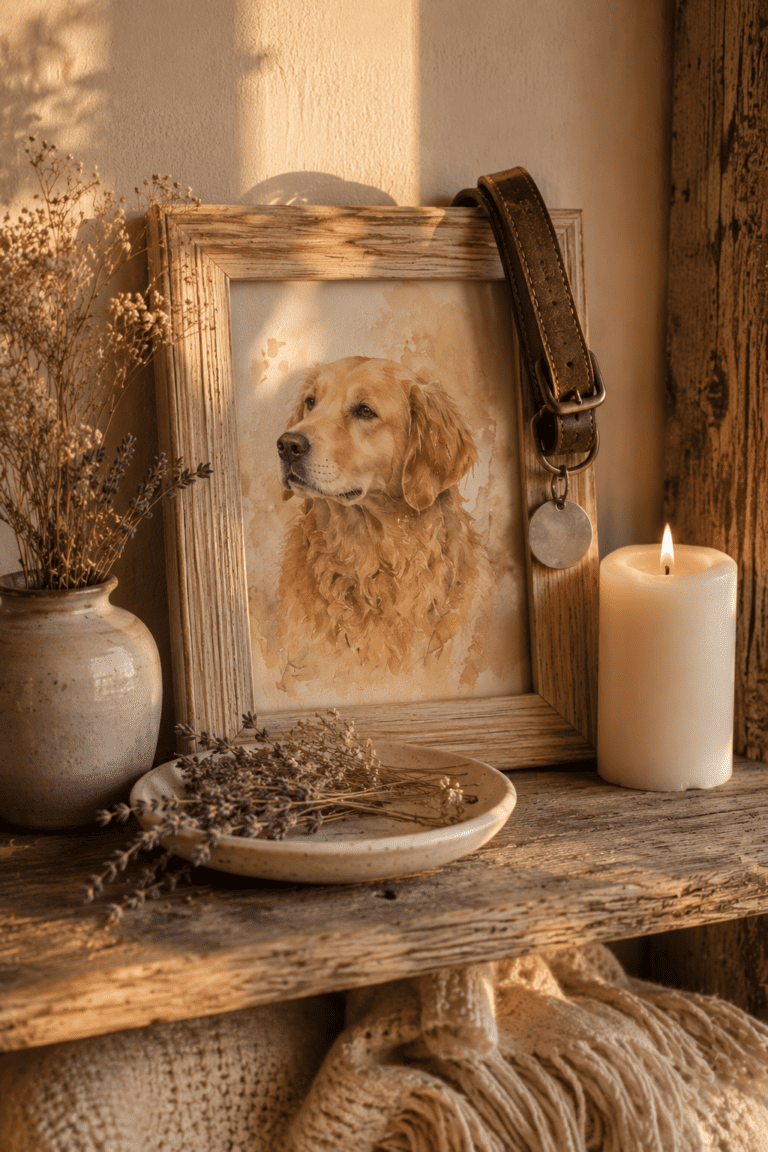
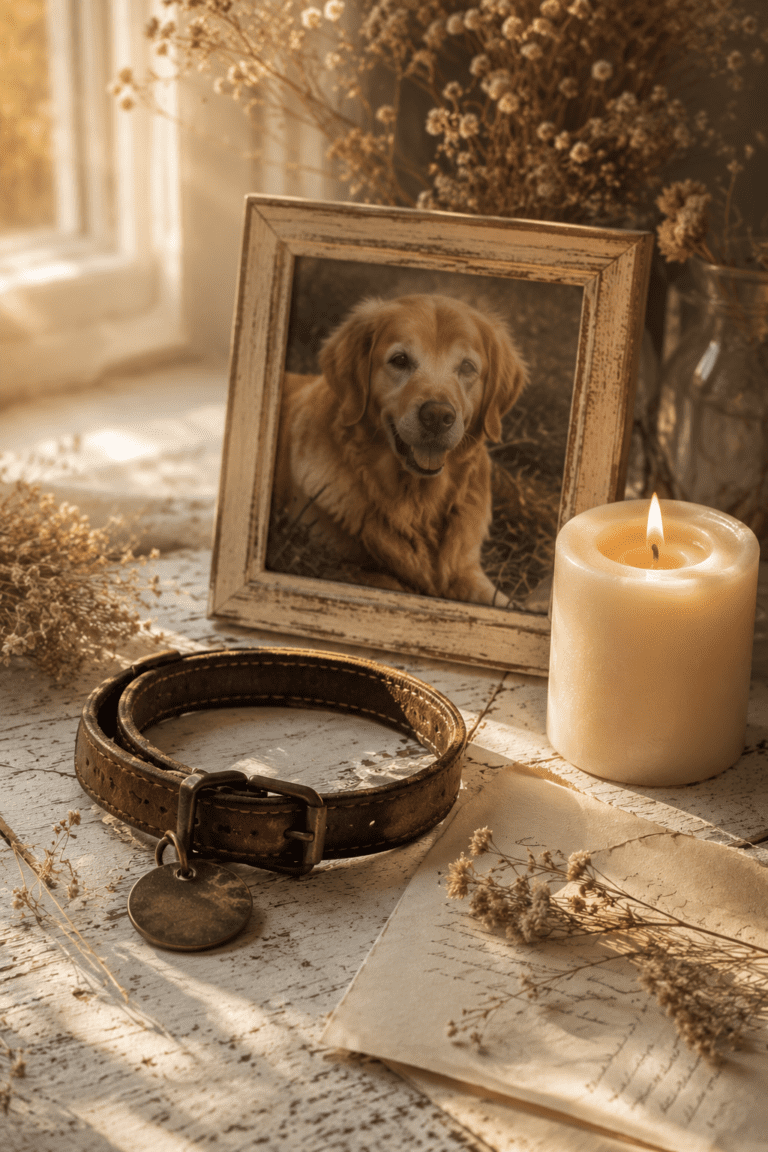
It doesn’t have to be elaborate. A single framed photo in the right place. A small corner of your home that says quietly — you were here, and you mattered.
The act of doing something with the love is one of the most healing things available to a grieving person. It turns loss into honoring. It gives the grief a shape it can work with.
Let the Hard Moments Be Hard
There will be ambushes.
A smell. A sound. Someone else’s dog who moves the same way. The pet food aisle. A voicemail you forgot you saved. A coat pocket with a treat still in it.
These moments will undo you completely and arrive without warning for longer than you expect. That’s not a sign that something is wrong with your grief — it’s a sign that the love was real and the relationship was real and your nervous system is still catching up to an absence it didn’t choose.
Let those moments happen. Don’t rush through them. Don’t apologize for them.
They get further apart over time. The love doesn’t get smaller — you just get bigger around it.
There Is No Timeline

Somewhere along the way someone decided that there were appropriate windows for grief. That after a certain point, continuing to mourn becomes excessive. That the right response to loss is to move through it efficiently and arrive at acceptance on schedule.
This is not true and it has never been true.
Grief moves at the speed of love, not at the speed of other people’s comfort. You will be done grieving when you are done grieving — which might be sooner than you expect, or longer, or it might be something you carry quietly for the rest of your life and that’s okay too.
The goal was never to stop loving them.
The goal is to get to a place where the love feels like something you carry with you rather than something crushing you. Where you can think of them and feel grateful — for the years, the ordinary days, the specific irreplaceable way they existed in the world and in your life.
That shift happens differently for every person and every animal. Give yourself the full weight of the time it takes.
A Note for the Losses That Feel Impossible
Some losses are not just losses — they’re losses that arrive too soon, or under circumstances that make the grief more complicated. The animal who was taken unexpectedly. The one you had to make an impossible decision for. The one who was sick for a long time and whose absence is tangled up with relief and then guilt about the relief.
If that’s the loss you’re carrying — there’s no reframe for it. No perspective that makes it okay. Some things are just hard and they stay hard for a while.
Be especially gentle with yourself if the circumstances were complicated. You did the best you could with what you had. That matters even when it doesn’t feel like enough.
The world will keep moving at its usual speed. People will say the wrong things with good intentions. Some days will be fine and some days the bowl by the back door will be the thing that completely undoes you.
All of that is part of it.
What remains, underneath all of it, is the truth that you loved something well. That an animal moved through this world and was known and cared for and genuinely loved. That their life was better because you were in it.
That’s not nothing. That’s everything.